

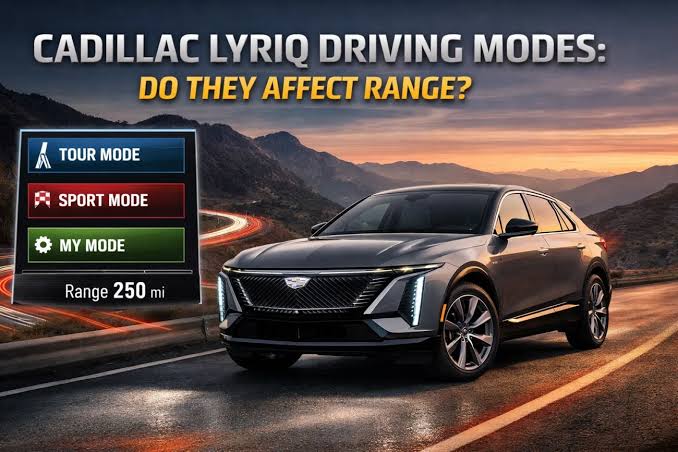
If you’ve spent any time behind the wheel of a f, you’ve probably noticed the little toggle that lets you switch between Tour, Sport, Snow/Ice, and My Mode. It’s a small button with a surprisingly big question attached to it: does flipping that switch actually change how far you can drive on a charge? Or is it mostly a personality setting that changes the steering feel and pedal response without touching your battery life in any meaningful way?
This is one of the most common questions new Lyriq owners ask, and honestly, it’s a smart one to ask. Electric vehicles live and die by their range, and understanding how your daily driving choices affect that number can save you from range anxiety, unexpected charging stops, and a lot of mental math on longer trips. So let’s dig into what’s really happening under the hood — or more accurately, under the battery pack — when you switch modes in Cadillac’s flagship electric SUV.
Understanding the Lyriq’s Driving Modes at a Glance
Cadillac built the Lyriq with a handful of selectable drive modes, each designed to adjust the vehicle’s throttle mapping, steering weight, suspension tuning (on trims equipped with adaptive dampers), and traction control behavior. The main modes include:
- Tour Mode – the default, balanced setting for everyday driving
- Sport Mode – sharper throttle response and firmer steering feel
- Snow/Ice Mode – reduced power delivery for slippery conditions
- My Mode – a customizable setting where you can mix and match preferences
Each of these modes was engineered with a specific driving experience in mind, not purely with range optimization as the goal. That distinction matters a lot when we start talking about battery consumption.
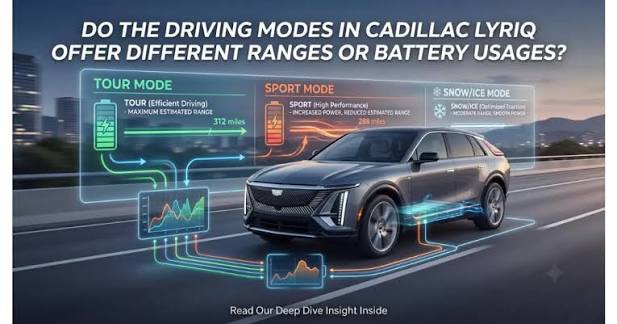
Do the Driving Modes in Cadillac Lyriq Offer Different Ranges or Battery Usages?
Here’s the short answer: yes, the driving modes in the Cadillac Lyriq do affect your range and battery usage, but the difference is more about how you use the throttle in each mode than the mode itself flipping some hidden efficiency switch. Sport Mode encourages quicker acceleration and a more aggressive right foot, which naturally pulls more energy from the battery pack. Tour Mode, being the default and most conservative setting, tends to deliver the best real-world range for typical commuting and highway driving.
Snow/Ice Mode isn’t really designed for maximizing range at all — its job is traction and safety, though it does soften acceleration in a way that can indirectly help efficiency in cold-weather driving. My Mode sits somewhere in the middle, since its impact on range depends entirely on which settings you’ve dialed in.
So while there’s no massive, night-and-day range gap baked into the software the way you might see with a dedicated “Eco Mode” on some other EVs, the modes absolutely do influence how efficiently your Lyriq uses its battery over the course of a drive.
How Each Driving Mode Affects Range
Tour Mode: The Everyday Efficiency Champion
Tour Mode is where most Lyriq owners spend the majority of their time, and for good reason. It offers a smooth, linear power delivery that doesn’t tempt you into flooring the accelerator every time a light turns green.
Because the throttle mapping is more gradual in Tour Mode, drivers naturally use less peak power, which translates into better efficiency numbers. Many owners report their best range figures — often close to or matching the EPA-estimated range — when driving primarily in this mode.
Sport Mode: Fun, But It Costs You Range
Switch over to Sport Mode and the personality of the Lyriq changes almost instantly. The throttle becomes noticeably more responsive, the steering firms up, and the SUV feels eager to launch off the line.
That eagerness comes at a price. Quicker acceleration means higher instantaneous power draw from the battery, and if you’re consistently driving in Sport Mode with a heavy foot, you’ll likely see your range estimate drop faster than it would in Tour Mode. It’s not unusual for owners to report a 10-15% dip in real-world range when driving aggressively in Sport Mode compared to a more relaxed Tour Mode commute.
Snow/Ice Mode: Built for Grip, Not Range
Snow/Ice Mode dulls throttle response and adjusts traction control to help the Lyriq maintain grip on slick roads. While it’s not marketed as an efficiency mode, the gentler acceleration curve can actually help conserve battery in certain situations, simply because it discourages sudden power spikes.
That said, cold weather itself is the bigger factor here. Battery chemistry just doesn’t perform as well in freezing temperatures, so any efficiency gains from Snow/Ice Mode can be offset by the natural range loss that comes with cold-weather EV driving.
My Mode: Customization With Consequences
My Mode lets drivers fine-tune settings like steering weight, throttle response, and suspension firmness (where equipped) to their liking. If you configure My Mode with a light throttle response similar to Tour Mode, you’ll likely see similar efficiency. Configure it closer to Sport Mode settings, and your range will trend downward accordingly.
This flexibility is actually one of the more underrated features for range-conscious owners, since it lets you essentially build a custom “Eco-lite” profile without sacrificing the parts of the driving experience you enjoy.
Real-World Range Differences Between Modes
Numbers from owner forums, EV range trackers, and independent test drives paint a fairly consistent picture. While exact figures vary based on temperature, tire pressure, terrain, and driving habits, general trends look something like this:
- Tour Mode: Closest to EPA-estimated range, often within a few percentage points
- Sport Mode: Typically 8-15% less range under spirited driving conditions
- Snow/Ice Mode: Range varies widely due to cold-weather battery effects, but throttle behavior itself is conservative
- My Mode: Range mirrors whatever throttle and power settings you’ve selected
It’s worth noting that these aren’t fixed, guaranteed numbers — they’re patterns based on how people typically drive in each mode. A gentle driver in Sport Mode might still get solid range, while an aggressive driver in Tour Mode could burn through battery faster than expected.
What Actually Drains the Battery in Each Mode
It helps to understand that the driving mode itself isn’t directly consuming energy — your inputs within that mode are. A few factors matter more than the mode selection alone:
- Acceleration habits – Quick, frequent acceleration burns significantly more energy than gradual, smooth inputs
- Speed – Highway speeds above 65-70 mph reduce range regardless of mode due to aerodynamic drag
- Climate control usage – Heating and cooling systems pull directly from the battery, sometimes more than the drivetrain itself in extreme weather
- Regenerative braking settings – How aggressively you use regen braking affects how much energy you recapture
- Terrain and elevation changes – Hilly routes demand more power than flat ones
So when people ask whether the driving modes in Cadillac Lyriq offer different ranges or battery usages, the honest answer involves this nuance: the mode sets the stage for how you’ll likely drive, but your actual habits within that mode are what determine the final number on your range estimator.
Tips to Maximize Range Regardless of Driving Mode
If you’re trying to squeeze the most miles out of every charge, a few practical habits go a long way no matter which mode you’re in:
- Accelerate gradually instead of flooring it from a stop
- Use one-pedal driving and regenerative braking whenever possible
- Precondition the cabin while still plugged in, especially in cold weather
- Keep tire pressure at the manufacturer-recommended level
- Reduce highway speeds slightly on long trips when range is tight
- Limit unnecessary use of heated seats and steering wheel if you’re relying on cabin heat
These small adjustments often make a bigger difference than the mode selection itself, especially for drivers who alternate between modes throughout the day.
Do the Driving Modes in Cadillac Lyriq Offer Different Ranges or Battery Usages? What Owners Report
Talk to enough Lyriq owners and you’ll hear a fairly consistent story. Most describe Tour Mode as their “road trip mode” because it stretches range the furthest, while Sport Mode gets reserved for weekend drives or moments when they simply want to enjoy the instant torque an electric SUV can deliver.
Several owners on EV forums have shared side-by-side comparisons showing noticeably lower remaining range percentages after identical routes driven in Sport Mode versus Tour Mode. While these aren’t controlled lab tests, the consistency of the pattern across different owners adds real-world credibility to what Cadillac’s engineering suggests: driving mode influences behavior, and behavior influences battery usage.
This lines up with what most EV experts have found across brands — the driving mode is less like a fuel-saving switch and more like a mood setting that nudges your right foot in a certain direction.
Comparing Lyriq’s Driving Modes to Other EVs
If you’ve driven other electric vehicles, you might expect a dedicated “Eco Mode” that dramatically extends range by limiting top speed and power output. The Lyriq doesn’t take quite that approach. Instead, Tour Mode already functions as the de facto efficiency setting, without needing a separate label.
This is a bit different from some competitors that offer a distinct low-power Eco Mode capable of adding noticeably more range through hard power limiting. Cadillac’s philosophy leans more toward a refined, balanced default rather than a bare-bones efficiency mode, which some owners appreciate for its smoother, more premium feel even when trying to conserve energy.
Final Thoughts on Driving Modes and Battery Usage
At the end of the day, the driving modes in the Lyriq aren’t just cosmetic settings — they genuinely shape how efficiently your battery gets used, largely because they shape how you drive. Tour Mode remains the most efficient choice for daily driving and long trips, Sport Mode trades range for excitement, and Snow/Ice Mode prioritizes safety over efficiency, with My Mode offering a customizable middle ground.
If range is your top priority, sticking with Tour Mode and adopting smooth acceleration habits will get you the most consistent results. But if you occasionally want to enjoy the Lyriq’s genuinely quick acceleration, know that Sport Mode will cost you some range — and that’s a trade-off many owners find well worth it for the driving experience.
Conclusion
So, do the driving modes in Cadillac Lyriq offer different ranges or battery usages? Yes, they do, though the difference comes more from how each mode encourages you to drive than from some hidden efficiency algorithm working behind the scenes. Tour Mode remains your best bet for maximizing range, Sport Mode delivers a noticeably sportier feel at the cost of some battery life, and Snow/Ice Mode prioritizes safety in tough conditions. Understanding these nuances helps you plan your trips smarter, avoid unexpected range surprises, and get the most out of your Lyriq’s battery, whichever mode you choose to drive in.
FAQ Section
1. Do the driving modes in Cadillac Lyriq offer different ranges or battery usages in a significant way? Yes, though the difference is moderate rather than dramatic. Tour Mode typically offers the best range, while Sport Mode can reduce range by roughly 8-15% depending on driving style.
2. Which Lyriq driving mode gives the best range? Tour Mode generally provides the most efficient driving experience and the range closest to the EPA estimate, thanks to its smoother throttle mapping.
3. Does Sport Mode drain the Lyriq’s battery faster? Yes, Sport Mode encourages quicker acceleration and firmer throttle response, which increases power draw and typically results in lower overall range compared to Tour Mode.
4. Is there a dedicated Eco Mode on the Cadillac Lyriq? Not exactly. The Lyriq doesn’t have a separate Eco Mode; instead, Tour Mode functions as the default, efficiency-friendly setting for everyday driving.
5. Does cold weather affect range more than the driving mode selected? In many cases, yes. Cold temperatures can reduce battery efficiency significantly, sometimes more than the driving mode itself, especially when climate control is used heavily.
