

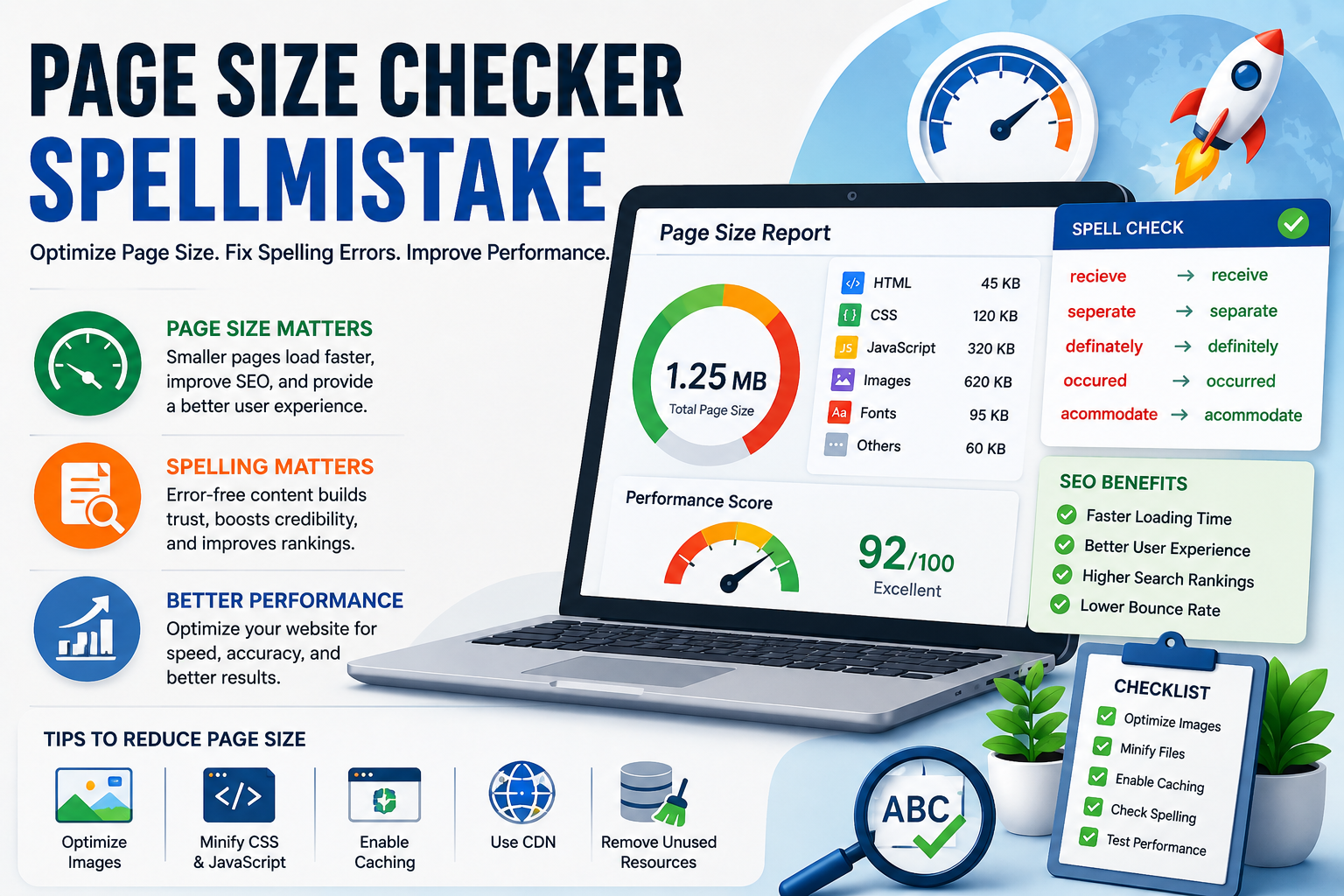
Website performance has become one of the most important factors in creating a successful online presence. Whether you run a personal blog, an online store, or a corporate website, every second of loading time influences how visitors interact with your content. At the same time, spelling accuracy plays a major role in maintaining credibility and improving user experience. These two concepts often come together when people search for page size checker spellmistake, a keyword that reflects both technical and content-related concerns.
Many users type search phrases quickly without paying close attention to spelling. Others may not know the exact name of the tool they need, so they combine different ideas into a single search query. This article explains what page size checking involves, why spelling matters, how website performance is measured, and what practical steps you can take to build a faster and more professional website.
What Does Page Size Mean?
Every webpage consists of multiple files that work together to display content in a browser. These include HTML documents, CSS stylesheets, JavaScript files, images, fonts, videos, icons, and other digital assets.
When a visitor opens a webpage, the browser downloads each of these resources. The combined size of all downloaded files is known as the page size. It is generally measured in kilobytes (KB) or megabytes (MB).
A lightweight webpage loads more quickly because less data needs to be transferred. Larger pages usually require more time to load, particularly on slower internet connections or mobile networks.
Website owners regularly analyze page size to identify unnecessary files that reduce overall performance.
Why People Search for Page Size Checker Spellmistake
Search engines process millions of imperfect searches every day. Users often make typing mistakes, misspell words, or combine several topics into one search.
The keyword page size checker spellmistake is a good example of mixed search intent.
Someone using this search phrase may be trying to find:
A webpage size analyzer.
A website speed testing tool.
A spelling correction service.
A content proofreading application.
A technical SEO checker.
A file size calculator.
Rather than focusing only on the wording itself, it is more useful to understand the problem behind the search. In most cases, users want to improve website quality through better performance or more accurate content.
Why Website Size Influences Performance Page Size Checker Spellmistake
Page size has a direct impact on how quickly visitors can access your content.
Large files require more bandwidth, take longer to download, and increase loading times. Slow websites frustrate visitors and often cause them to leave before interacting with the page.
Fast-loading websites create a smoother browsing experience. Visitors are more likely to continue reading, explore additional pages, and complete purchases or inquiries.
Performance also affects websites with international audiences, where internet speeds vary significantly across different regions.
Reducing unnecessary page weight helps deliver content more efficiently regardless of the visitor’s device or location.
The Main Elements That Affect Page Size Page Size Checker Spellmistake
Understanding what contributes to page weight helps developers optimize websites more effectively.
Images are usually the largest files on a webpage. Uploading full-resolution photographs without compression increases loading times considerably.
JavaScript enables interactive features but can also become excessive if multiple libraries or plugins are installed.
CSS controls the appearance of webpages. Large or outdated stylesheets often contain unused code that still needs to be downloaded.
Videos, animations, downloadable documents, and custom fonts all contribute to overall page size.
Third-party scripts such as advertising platforms, analytics tools, chat widgets, and social media integrations also increase the amount of data transferred during page loading.
What Makes a Webpage Large?
Many websites become unnecessarily heavy because multiple elements accumulate over time.
High-resolution images are among the biggest contributors. Uploading photographs directly from a camera without optimization can dramatically increase page size.
JavaScript libraries also add significant weight. Some websites include several frameworks, plugins, and tracking scripts that load on every page, even when they are not needed.
Large videos, custom fonts, animations, background graphics, and embedded widgets further increase download size.
Poor coding practices, unused CSS, duplicate scripts, and excessive plugins can also slow down websites considerably.
Regular performance audits help identify these issues before they impact users.
Common Causes Behind Slow Page Loading
Slow loading pages are rarely caused by a single issue. Instead, several factors often combine to reduce performance.
Oversized images remain one of the most common problems. Modern image formats such as WebP and AVIF provide much better compression than older formats while maintaining excellent visual quality.
Render-blocking CSS and JavaScript prevent browsers from displaying content until critical files finish loading.
Unoptimized fonts may require several additional downloads before text becomes visible.
Poor server response times, excessive redirects, and large database queries can also delay page rendering.
Identifying these bottlenecks allows website owners to prioritize the improvements that deliver the greatest performance gains.
Why Spelling Accuracy Still Matters Page Size Checker Spellmistake
Although technical optimization is important, content quality should never be overlooked.
Visitors naturally expect websites to use correct spelling and grammar. Frequent errors make content appear rushed or unreliable.
Spelling mistakes may appear in blog articles, product descriptions, navigation menus, image filenames, metadata, downloadable resources, or even website URLs.
The keyword page size checker spellmistake reminds us that many online searches involve typing errors. While search engines often understand user intent, website owners should always publish carefully proofread content.
Professional writing builds confidence and encourages readers to trust the information being presented.
How Search Engines Evaluate Website Quality Page Size Checker Spellmistake
Modern search engines evaluate hundreds of different signals before determining search rankings.
Content relevance remains one of the most important factors, but technical performance also plays a supporting role.
Search engines consider elements such as loading speed, mobile friendliness, page responsiveness, structured content, and overall user experience.
A fast website with useful information generally performs better than one that loads slowly and provides limited value.
Website owners who optimize both technical and editorial aspects create stronger long-term foundations for search visibility.
Understanding User Experience Page Size Checker Spellmistake
User experience extends far beyond attractive design.
Visitors want websites that load quickly, display correctly across different devices, and provide information without unnecessary distractions.
A positive experience includes:
Easy navigation.
Readable typography.
Fast page loading.
Clear organization.
Relevant content.
Accessible design.
Reliable performance.
When users enjoy browsing a website, they are more likely to return in the future and recommend it to others.
Common Reasons Websites Become Slow Page Size Checker Spellmistake
Many websites gradually become slower without owners realizing it.
Large image galleries, unnecessary plugins, outdated themes, excessive advertising, and multiple tracking scripts all contribute to growing page sizes.
In some cases, businesses continue adding features over several years without removing outdated resources.
Regular website maintenance helps identify these issues before they begin affecting visitors.
Even small reductions in page size can noticeably improve loading performance.
Website Optimization Is an Ongoing Process Page Size Checker Spellmistake
Optimizing a website is not something that happens only once.
As new content is published and additional features are introduced, page sizes naturally increase over time.
Routine performance reviews help developers identify opportunities for improvement before problems become severe.
Compression, caching, code cleanup, and image optimization should become regular parts of website management rather than occasional tasks.
This ongoing approach helps maintain consistent performance while supporting future growth.
Mobile Devices Make Optimization Even More Important
Today, many users browse the internet primarily through smartphones and tablets.
Mobile connections may be slower or less stable than traditional broadband, making page size even more significant.
Heavy webpages consume additional mobile data and require longer download times.
Optimized websites provide better experiences across different screen sizes while reducing unnecessary bandwidth usage.
Responsive design combined with efficient resource management allows websites to perform well regardless of the device being used.
The Connection Between Technical SEO and Page Analysis
Technical SEO focuses on helping search engines efficiently crawl, understand, and index websites.
Page analysis includes examining file sizes, loading behavior, code efficiency, server responses, caching policies, image optimization, and resource delivery.
Instead of treating page size checker spellmistake as only a keyword, website owners should view it as part of a broader strategy for improving technical quality.
A well-maintained website is easier for search engines to process and provides a smoother experience for visitors.
Practical Ways to Reduce Website Size Page Size Checker Spellmistake
Several proven techniques can significantly reduce page weight without affecting visual quality.
Compressing images before uploading them saves bandwidth while preserving appearance.
Modern image formats improve efficiency compared to older file types.
Removing unused CSS and JavaScript eliminates unnecessary downloads.
Minifying code removes extra spaces and formatting that browsers do not require.
Browser caching allows returning visitors to load pages much faster because many files are stored locally.
Using content delivery networks helps deliver website resources from servers located closer to users, reducing loading delays across different regions.
These improvements work together to create websites that are both attractive and highly efficient, providing a better experience for visitors and stronger technical performance for search engines.
How to Identify Performance Problems Page Size Checker Spellmistake
Improving a website begins with understanding what is slowing it down. Many website owners assume that a slow page is caused by poor hosting, but the real issue is often the amount of data being loaded.
A detailed performance review looks at the total size of a webpage, the number of requests made to the server, loading order, image optimization, and the efficiency of scripts. By identifying the largest resources first, developers can prioritize improvements that produce the greatest impact.
This is one reason why searches related to page size checker spellmistake continue to appear. People want simple ways to identify problems that affect speed and usability.
The Importance of Image Optimization
Images make websites more engaging, but they also account for a large percentage of total page weight.
Uploading oversized images directly from a digital camera or smartphone often creates unnecessary delays. In many cases, visitors cannot even notice the difference between the original image and a properly compressed version.
Choosing the correct dimensions before uploading, using modern image formats, and enabling lazy loading can dramatically reduce loading times while maintaining excellent visual quality.
A website with optimized images performs better on both desktop and mobile devices.
Why Clean Code Matters
Behind every webpage is code that tells browsers how to display content.
Over time, websites often accumulate unused CSS rules, outdated JavaScript libraries, and duplicate files. These resources increase download size even though they may no longer serve any purpose.
Cleaning and organizing code helps browsers process webpages more efficiently. Smaller files also reduce bandwidth usage and improve the experience for users with slower internet connections.
Maintaining clean code is a simple habit that supports long-term website performance.
The Relationship Between Speed and User Trust
Visitors form opinions about a website within seconds.
If a page loads quickly and presents well-written, error-free content, users are more likely to trust the information. Slow loading pages combined with obvious spelling mistakes can create a negative first impression.
Trust is especially important for businesses, educational platforms, healthcare websites, and online stores where users expect professionalism.
Improving both technical performance and content accuracy creates a stronger overall experience.
Page Size and Mobile Performance
Mobile browsing has become the primary way many people access the internet.
Unlike desktop users with fast broadband connections, mobile users may rely on limited data plans or weaker network coverage. Large webpages consume more data and take longer to load under these conditions.
Optimizing page size benefits mobile visitors by reducing waiting time, improving responsiveness, and lowering data usage.
Since search engines prioritize mobile-friendly experiences, efficient pages also support better visibility in search results.
Building Better Content Alongside Better Performance
Fast websites alone are not enough to attract and retain readers.
Visitors expect informative articles, clear explanations, and reliable information. Content should answer questions directly while remaining easy to understand.
Good writing also means using correct grammar, natural language, and logical organization. Even a technically perfect website can lose credibility if the content contains frequent spelling or formatting mistakes.
The phrase page size checker spellmistake highlights the importance of balancing technical optimization with editorial quality.
Common Misconceptions About Page Size
Many people believe that reducing page size always means removing valuable content. In reality, optimization focuses on improving efficiency rather than eliminating useful features.
Another misconception is that only large websites need performance improvements. Even small business websites and personal blogs benefit from faster loading times.
Some website owners also assume that purchasing faster hosting will solve every speed issue. While quality hosting is important, oversized images, unnecessary scripts, and inefficient code often remain the biggest contributors to slow performance.
Understanding these misconceptions helps website owners make more informed optimization decisions.
Future Developments in Website Optimization
Web technologies continue to evolve as user expectations grow.
Artificial intelligence is becoming increasingly useful for identifying performance issues, optimizing images, and recommending improvements automatically.
Browsers are also introducing smarter resource loading techniques that improve rendering efficiency.
New file formats continue to reduce image sizes while maintaining impressive visual quality.
As these technologies become more widely adopted, websites will continue becoming faster and more efficient without sacrificing design quality.
Frequently Asked Questions
What does page size mean on a website?
Page size refers to the total amount of data a browser downloads to display a webpage. This includes HTML, CSS, JavaScript, images, fonts, videos, and other resources.
Why do people search for page size checker spellmistake?
Many users accidentally combine different search intentions into one query. They may be looking for a webpage size analyzer, a spelling checker, or a website optimization tool but enter the phrase with typing errors.
Does page size affect SEO?
Yes. Although page size is not a direct ranking factor by itself, it influences loading speed, user experience, and technical performance, all of which contribute to effective search engine optimization.
What usually makes a webpage too large?
The most common causes include oversized images, excessive JavaScript, multiple third-party scripts, large font libraries, embedded videos, and unused CSS files.
How can website owners reduce page size?
They can compress images, remove unnecessary code, enable browser caching, minify CSS and JavaScript, optimize media files, and regularly review website performance.
Why is correct spelling important for websites?
Accurate spelling improves credibility, readability, and professionalism. Well-written content encourages visitors to trust the information and spend more time exploring the website.
Conclusion
The search phrase page size checker spellmistake may seem unusual at first glance, but it reflects two essential aspects of creating a successful website: technical efficiency and content accuracy. Understanding both allows website owners to improve performance while delivering a better experience for visitors.
Reducing unnecessary page weight helps webpages load faster, improves mobile usability, and supports technical SEO efforts. At the same time, eliminating spelling mistakes strengthens credibility, enhances readability, and creates a more professional online presence.
Website optimization is not a one-time project but an ongoing process of reviewing, testing, and improving. Regular maintenance, efficient coding practices, optimized images, and carefully proofread content work together to produce websites that satisfy both users and search engines.
As digital expectations continue to grow, websites that combine speed, clarity, and high-quality information will remain better positioned for long-term success. By focusing on continuous improvement instead of quick fixes, you can build an online presence that is fast, trustworthy, and valuable for every visitor.
